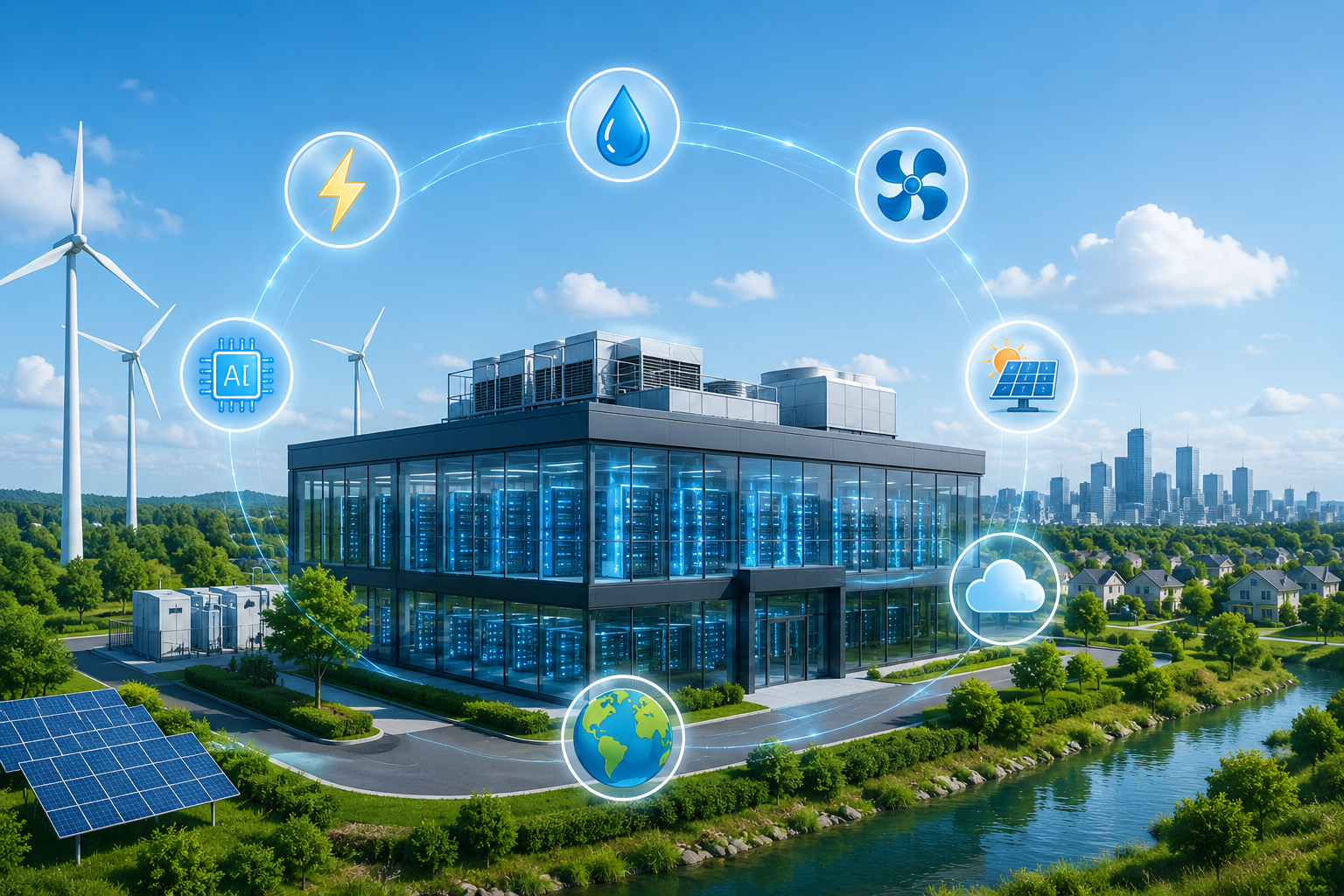
Have you ever think when you ask a question on AI(Artificial intelligence) tools how and from where it get answers?
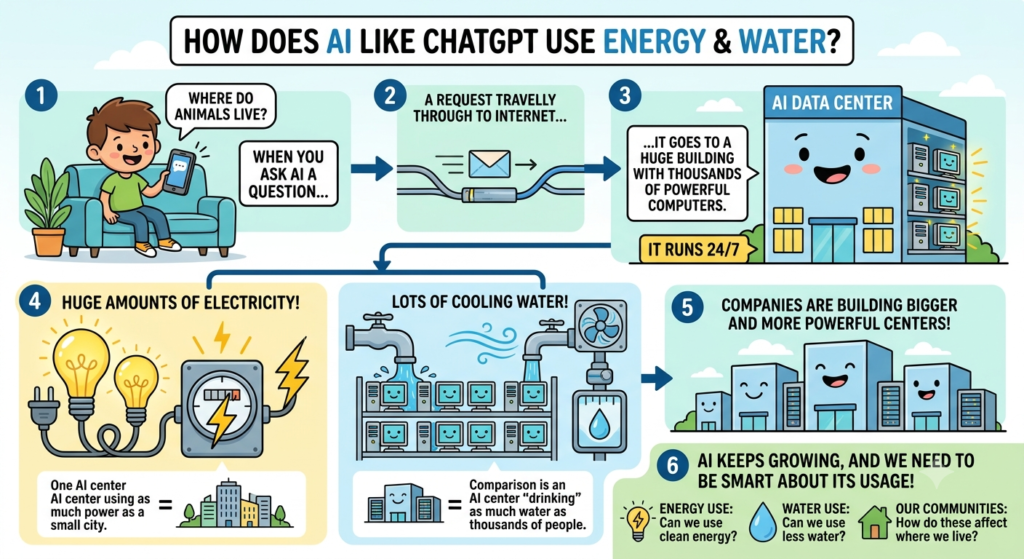
Every time you ask ChatGPT or any AI tool a question your request is sent to a data center a large building filled with thousands of powerful computers. These buildings run 24 hours a day and need huge amounts of electricity and cooling to keep the computers working. Many also use large amounts of water to stop the servers from overheating.
As AI becomes more popular companies are building bigger and more powerful data centers than ever before. While these facilities help power the digital world but they also raise important questions about energy use as well as water consumption and their impact on local communities.
What Is a Data Center?
A data center is a building built specifically to hold computers which are stacked in racks and it work nonstop.
Think of it less like an office and more like a power plant crossed with a warehouse. Instead of people working at desks, it’s servers processing requests loading your Instagram feed, saving your Google Drive files or generating an AI response.
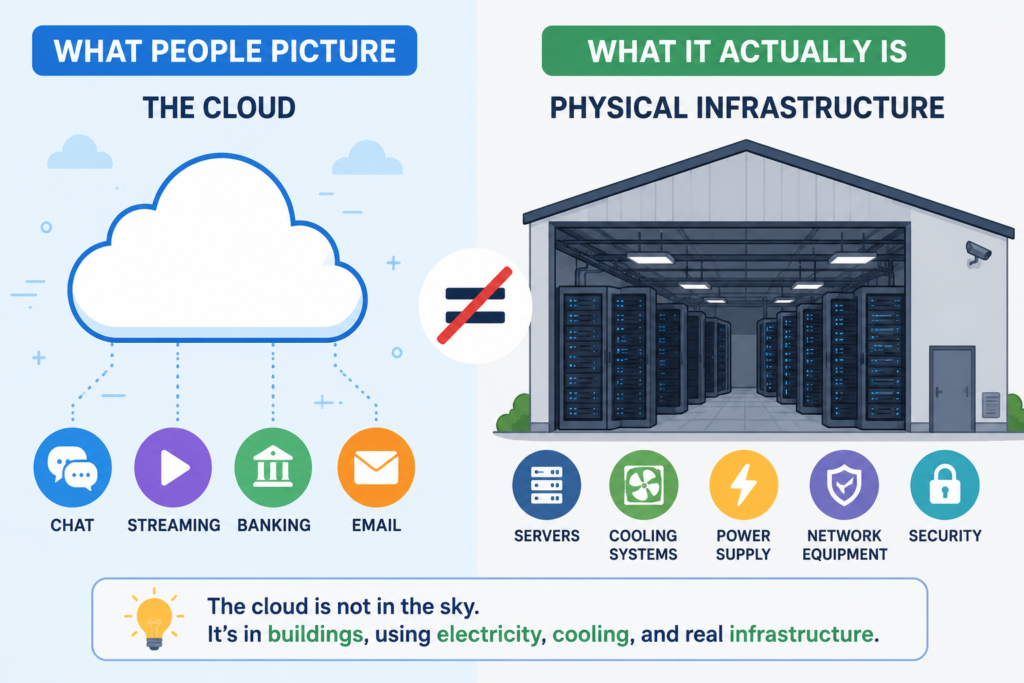
There’s nothing mysterious about “the cloud.” The cloud is just a friendly marketing term for someone else’s data center.
How Does an AI Data Center Work?
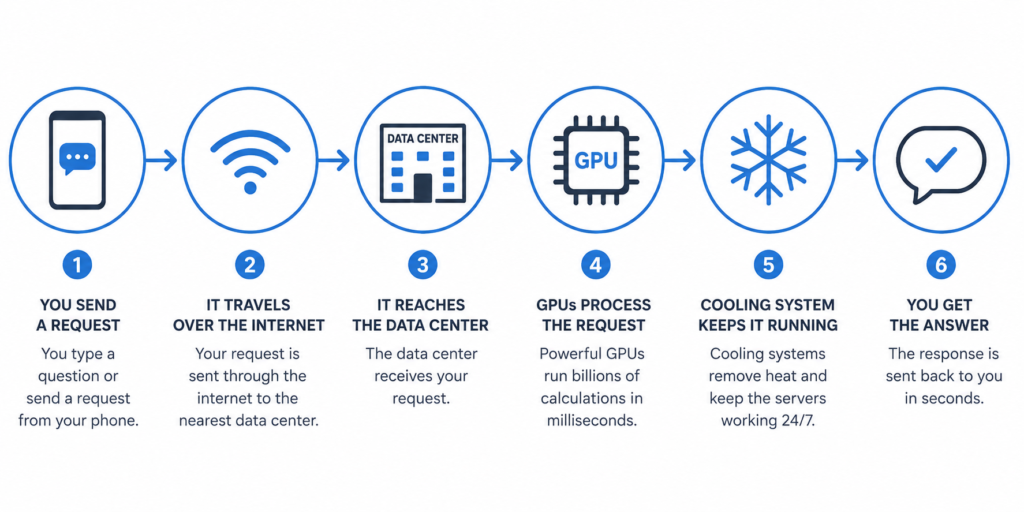
Every time you ask ChatGPT a question or use another AI tool, a few simple steps happen behind the scenes.
1. You ask a question.
For example you type, “What is a data center?”
2. Your question travels through the internet.
In just a fraction of a second it reaches a nearby AI data center.
3. Powerful computers start working.
Inside the data center thousands of high-performance computers use AI chips to understand your question and create an answer.
4. The computers get very hot.
Because they work so fast these servers produce a lot of heat. Cooling systems use air, water, or special liquids to keep them from overheating.
5. You receive the answer.
The completed answer is sent back through the internet and it appears on your phone or computer usually in less than a second.
Why Does AI Need More Power Than a Normal Search?
A normal search engine like Google, mainly helps you find information that already exists on websites.
AI works differently.
Instead of simply finding information AI creates a new answer by analyzing your question and predicting the best response. This requires many more calculations which means AI data centers need more powerful computers more electricity and better cooling systems.
This entire process usually takes less than a second and even though thousands of computers may work together to generate your response
Types of Data Centers
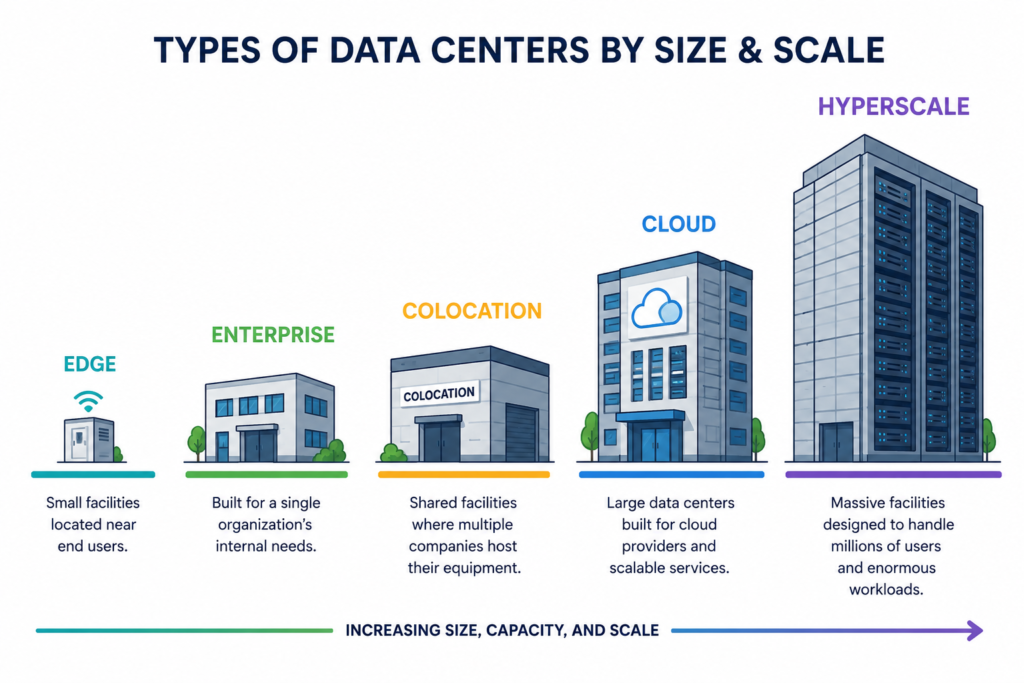
Not all data centers are the same. Some are small, while others are as big as several football fields. Each type has a different job.
Enterprise Data Centers
These data centers belong to a single company and are used only by that company. They store the company’s files and websites as well as business data.
Example: A large bank or hospital may have its own data center.
Colocation Data Centers
Think of this like an apartment building for computers.
Many companies keep their servers in the same building, but each company has its own space. They share things like electricity, cooling, and security.
Cloud Data Centers
These are very large data centers that provide online services to millions of people and businesses.
When you save photos online, watch videos, or use AI tools, your data is often stored in a cloud data center.
Examples: Amazon Web Services (AWS), Microsoft Azure, and Google Cloud.
Hyperscale Data Centers
These are the largest data centers in the world.
They contain thousands of powerful computers and are built to handle huge amounts of internet traffic and AI work, such as ChatGPT and other AI tools.
Many hyperscale data centers are as large as several football fields and use a lot of electricity and cooling to keep the computers running.
Edge Data Centers
Edge data centers are smaller buildings located closer to where people live and work.
Because they are nearby and they can send information faster. This helps reduce waiting time when you stream videos, play online games, or make video calls.
Simple Comparison
| Type | Best Explained As |
|---|---|
| Enterprise | One company owns and uses it. |
| Colocation | Many companies share one building. |
| Cloud | Provides online services to millions of users. |
| Hyperscale | Huge data centers that power AI and cloud computing. |
| Edge | Small data centers placed close to users for faster service. |
Think of it like this:
- Enterprise = Your own house.
- Colocation = An apartment building where many families live.
- Cloud = A giant shopping mall serving thousands of people every day.
- Hyperscale = A huge city built to power the internet and AI.
- Edge = A neighborhood convenience store that is close and quick to reach.
This simple comparison makes it easier to understand why different types of data centers exist and what each one is designed to do.
What’s Inside an AI Data Center
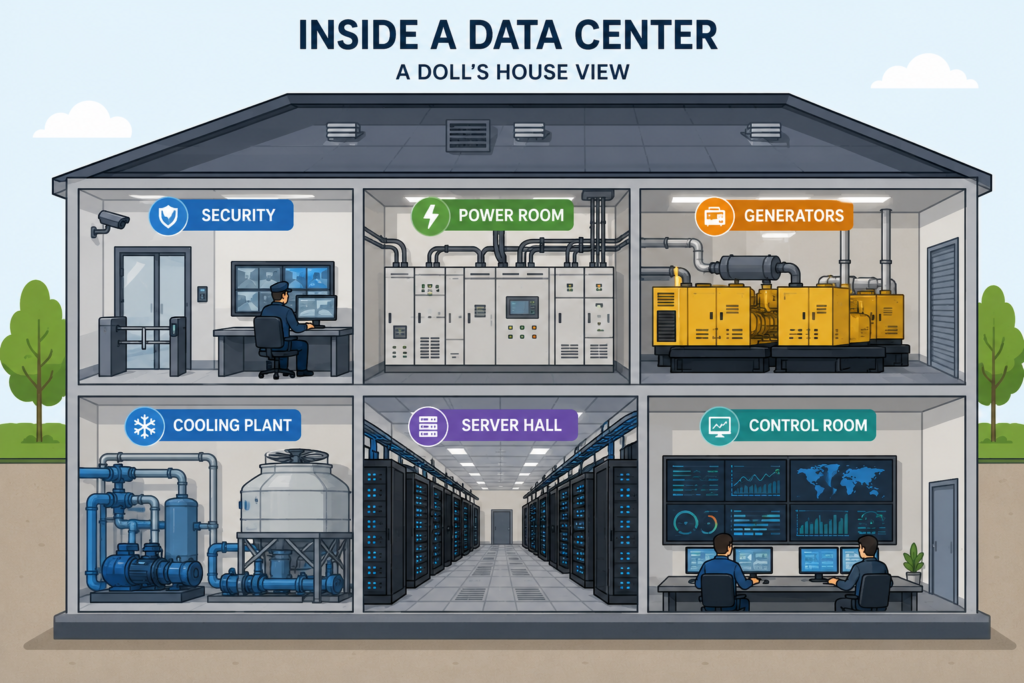
Walk through one of these buildings and you’d pass through:
- A guarded security checkpoint — these facilities are protected like banks
- A power room full of backup batteries
- Diesel generators, in case grid power ever fails
- A cooling plant running around the clock
- The server hall itself — endless rows of glowing racks
- A control room where engineers monitor everything in real time
Why Do AI Data Centers Use So Much Electricity?
AI data centers need a lot of electricity because they are filled with thousands of powerful computers working all day and all night.
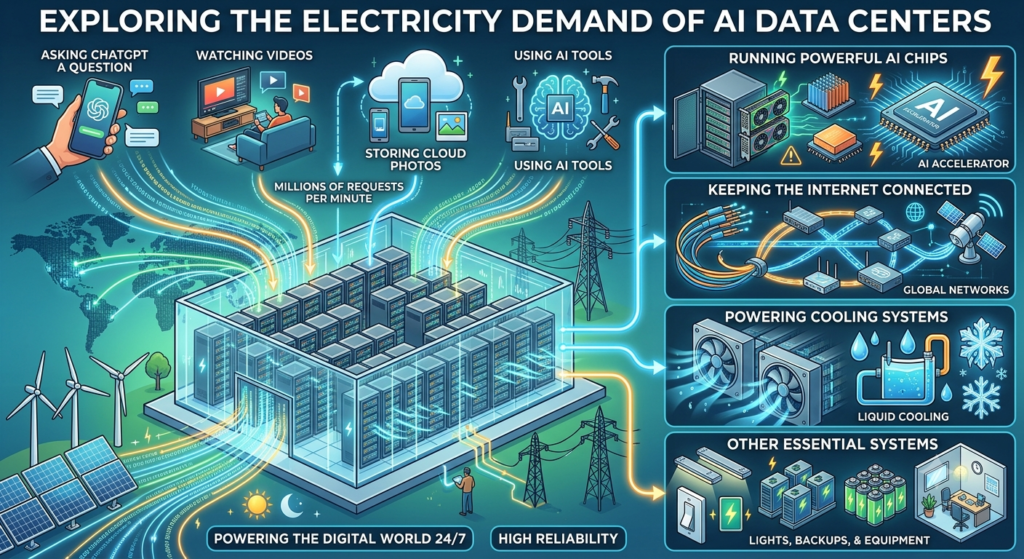
Every time someone asks ChatGPT a question, watches a video, stores photos in the cloud, or uses an AI tool, computers inside a data center start working. Imagine millions of people doing this at the same time. That means millions of requests are being processed every minute.
These computers use electricity to:
- Run powerful AI chips
- Keep the internet connected
- Power cooling systems
- Run lights and other equipment
- Charge backup batteries and emergency systems
AI Is Using More Electricity Every Year
As more people use AI, the need for electricity keeps growing.
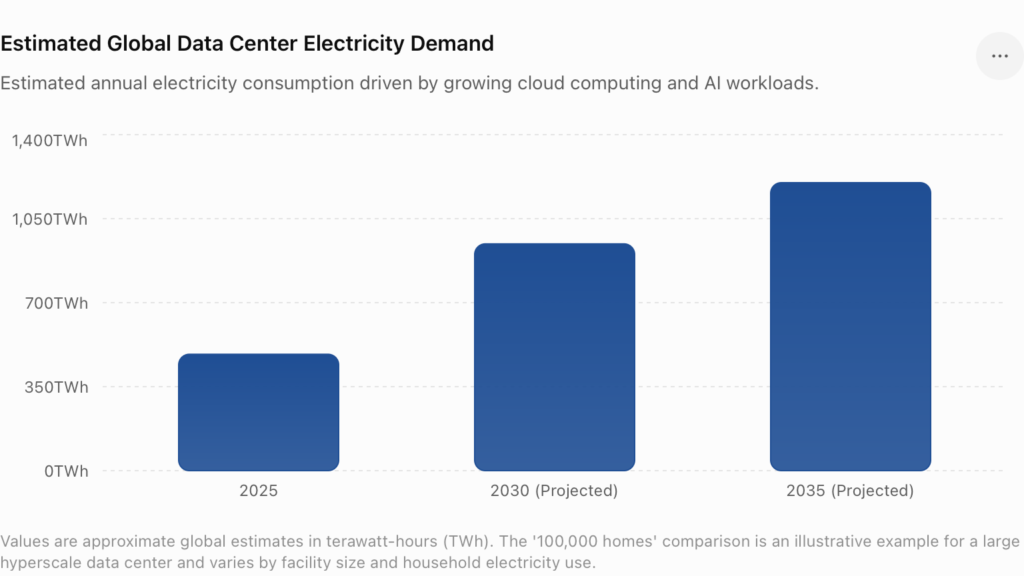
According to the International Energy Agency (IEA):
- Global data centers used about 460–490 terawatt-hours (TWh) of electricity in 2025.
- That was about 17% more than the year before.
- AI-focused data centers grew even faster with electricity demand increasing by around 50% in 2025.
Experts expect electricity use to keep increasing as AI becomes part of more apps, websites, schools, businesses, and workplaces.
How Much Is That?
It can be hard to imagine what 490 TWh means.
Think of it this way:
A large hyperscale AI data center can use about as much electricity as 100,000 homes, although the exact amount depends on the size of the facility and where it is located.
Not every area has the same number of data centers.
For example:
- Virginia, USA, has the world’s largest concentration of data centers. In some parts of the state data centers already use a significant amount of the local electricity supply.
- Ireland has also seen rapid growth in data centers. They now use a large portion of the country’s electricity, leading to discussions about energy planning and future development.
As AI continues to grow and one of the biggest challenges will be finding enough electricity while also increasing the use of cleaner energy sources such as solar, wind, hydroelectric, and nuclear power.
Did You Know?
A data center never “goes to sleep.”
Unlike a school or office that closes at night, data centers operate 24 hours a day, 7 days a week, so they can answer your requests anytime—whether it’s morning, afternoon, or the middle of the night.
Why Do AI Data Centers Need So Much Water?
AI data centers are filled with thousands of powerful computers that work day and night. As these computers process millions of AI requests which produce a lot of heat.
If the computers become too hot it can slow down or stop working. That’s why data centers need cooling systems.
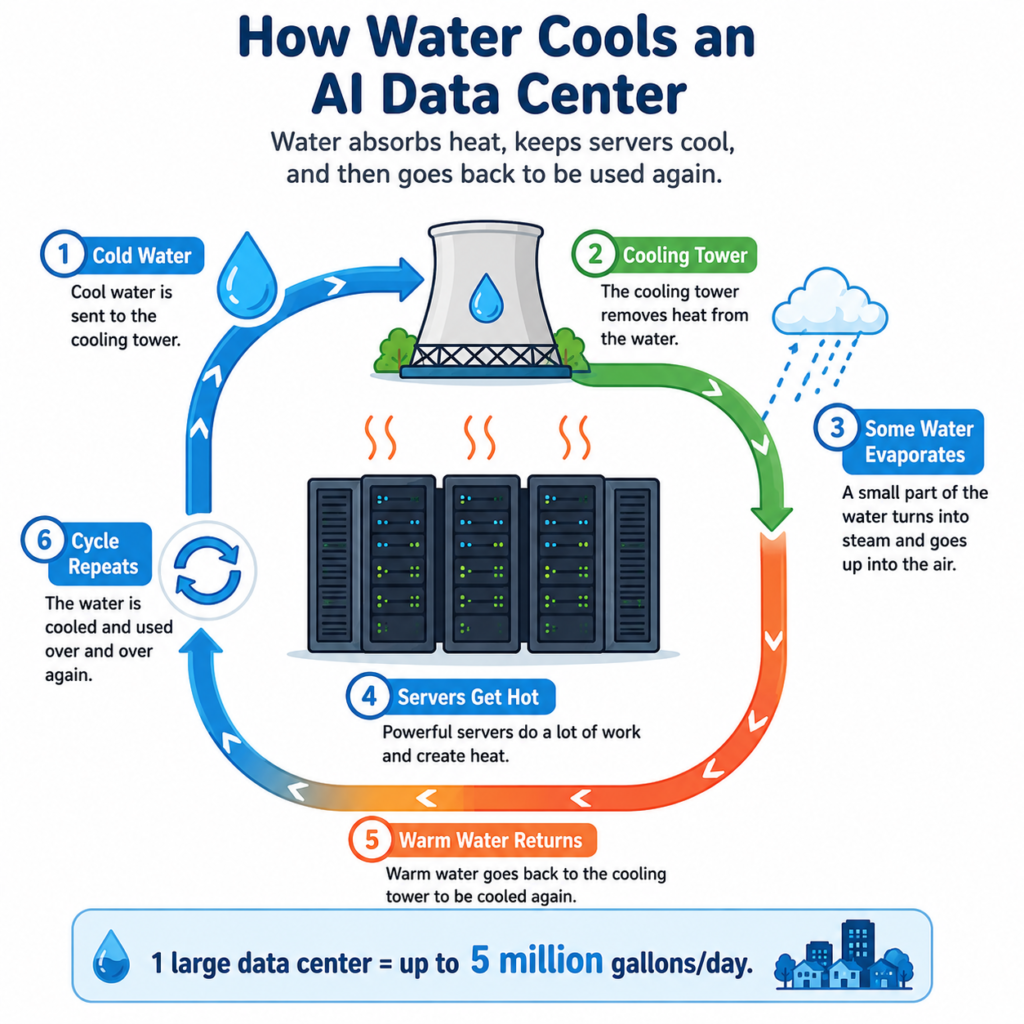
Many data centers use water to remove heat. It works in a simple way. Water flows through the cooling system, absorbs heat from the computers, and then some of it evaporates into the air. The remaining water is cooled and used again. This process helps keep the computers running safely.
How Much Water Do They Use?
The amount of water a data center uses depends on:
- Local weather
- The size of the data center
- The cooling technology
- How much AI work is being done
According to the Environmental and Energy Study Institute (EESI) some of the largest AI data centers can use 1 to 5 million gallons of water each day when operating at full capacity. That’s about the same amount of water a town of 10,000 to 50,000 people might use in a day.
A real example is Google’s data center in Council Bluffs, Iowa, which used about 1 billion gallons of water in 2024 for cooling and operations.
In Texas, researchers estimate that data centers could use around 49 billion gallons of water in 2025, with demand expected to grow as more AI facilities are built.
Not Every Data Center Uses the Same Amount of Water
The good news is that not all data centers need large amounts of water.
Some use:
- Air cooling
- Direct liquid cooling
- Recycled or reclaimed water
- More efficient cooling systems
Google has reported that one of its air-cooled data centers in Texas uses about 270 times less water per day than one of its water-cooled facilities in Iowa. This shows how much difference the cooling system can make.
Building Smarter Data Centers
Technology companies are working on new ways to reduce water use. Many are investing in:
- Better cooling technologies
- Recycled water instead of drinking water
- More energy-efficient computer chips
- Building data centers in cooler locations where less cooling is needed
The goal is to support the growing demand for AI while using water more wisely and reducing the impact on local communities and the environment.
Quick Facts
- Water helps keep powerful computers from overheating.
- More AI activity creates more heat.
- Larger data centers often need more cooling.
- New cooling technologies can greatly reduce water use.
- Many companies are investing in ways to save both water and energy.
The Full Environmental Impact
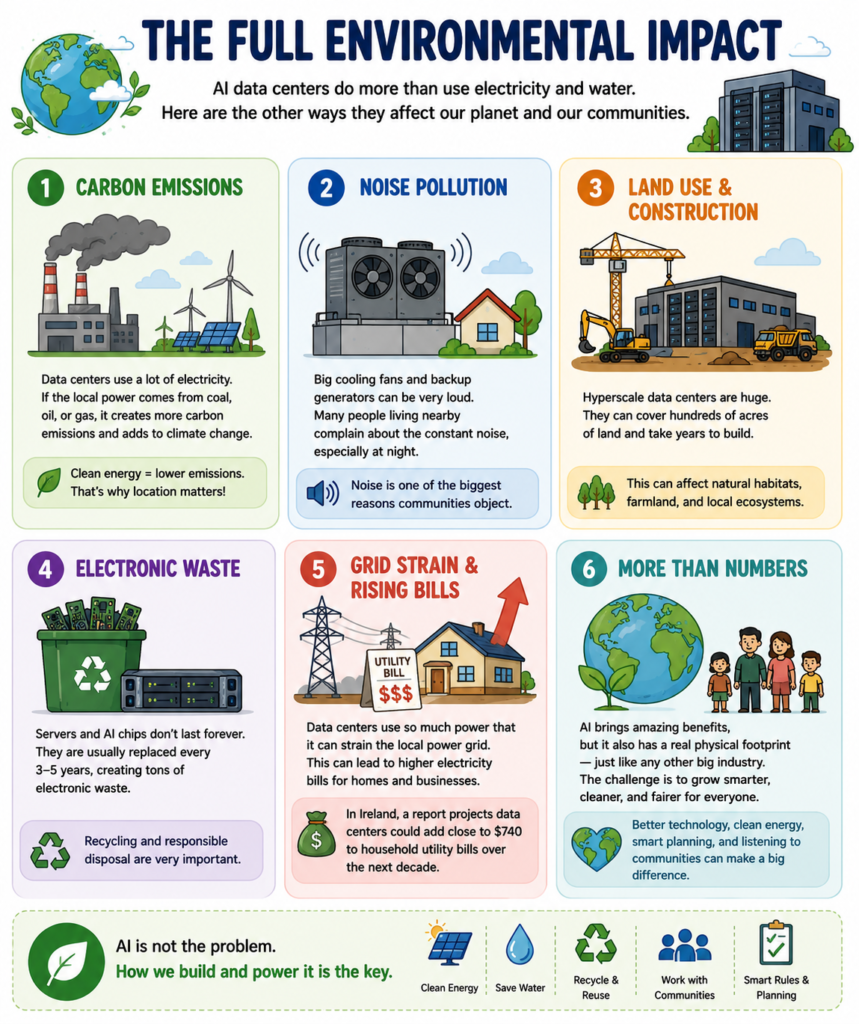
When people talk about AI data centers, they usually focus on electricity and water. But these buildings can affect the environment in other ways too.
Here are some of the main impacts:
Carbon Emissions
Data centers need a lot of electricity. If that electricity comes from coal, oil and natural gas, it can produce more carbon emissions. If it comes from solar, wind, hydro and nuclear power its environmental impact is lower.
Noise
Large cooling systems and backup generators can be noisy. People living near some data centers have complained about the constant sound especially at night.
Land Use
Some AI data centers are very large. The biggest ones can cover hundreds of acres which means a lot of land is needed for buildings, roads and power equipment.
Electronic Waste
Computers inside data centers do not last forever. Servers and AI chips are usually replaced every 3 to 5 years. Old equipment needs to be recycled or disposed of responsibly to reduce electronic waste.
Pressure on the Power Grid
As more AI data centers are built, they need more electricity. In some areas, this puts extra pressure on the local power grid. There are also concerns that the cost of upgrading power systems could increase electricity bills for homes and businesses.
Conclusion
AI is changing all the way we work, learn, live and communicate. Every time when we use AI like chat GPT or Gemini or search on the internet as well as watch video or save phone online, all this happened because of data center. These data center buildings are the important part of the world as they help power AI , cloud computing and online banking , education , banks and many more.
But on the opposite these data centers use electricity, water and land for computing and now the demand is increasing day by day which have both opportunity as well as challenge which raising the questions about energy use and impact on the environment of these data centers.
AI is the future but it’s not only about making buildings for data center which is not enough as its about making smarter and susainble ones with better cooling systems, clean energy uses, water recycle and research alternate ways which help to reduce environmentle impact.
So next time when use AI tools remember to use it wisely and smartly because every AI answer making impact on our earth.